The 11 Steps to Business Website SEO -
The Complete Guide to Organic Ranking in 2026
A business website without proper SEO is like a luxury store in the middle of the desert. You can invest in design, product, and service — but without visibility on Google, customers simply won't come. Here is everything you need to know to achieve lasting organic rankings in 2026.
The Foundation
What Is SEO and Why Is It Critical for Your Business?
Search Engine Optimization (SEO) is the discipline of improving your website's visibility in organic — unpaid — search results. In 2026, SEO has evolved far beyond simply placing keywords on a page. Modern SEO is a multi-layered strategy that combines four interlocking pillars:
- Technology — page speed, Core Web Vitals, mobile responsiveness, crawlability
- User Experience — intuitive navigation, clear structure, accessibility
- Authoritative Content — in-depth, accurate, genuinely helpful answers to real questions
- AI-Era Optimization — structure and signals that AI search engines can read, analyze, and cite
The Business Case for Professional SEO
- High-quality organic traffic with real purchase intent
- More inquiries and conversions — without per-click costs
- Long-term brand authority and credibility
- Significant savings on paid advertising budgets
- A compounding digital asset that keeps working for years
- Competitive advantage over businesses that neglect SEO
Unlike paid ads that vanish the moment you stop paying, organic SEO builds a permanent digital asset. A page that earns a strong ranking today will continue driving traffic next month, next year, and beyond — with no additional cost per visitor. This is why the businesses that invest in professional SEO consistently outperform competitors who rely entirely on paid channels.
The Full Roadmap
All 11 SEO Steps at a Glance
Before diving deep into each step, here is the full picture. These 11 steps represent a complete, professional SEO implementation — from the very first research phase through to continuous optimization. Each step builds on the previous, forming a coherent strategy rather than a list of isolated tasks.
Keyword Research
The treasure map of your site — knowing exactly what your customers search before you write a single word.
Correct Site Structure
A clear hierarchy that Google and users both love — logical, fast to navigate, easy to crawl.
Technical Optimization
Speed, security, mobile responsiveness, Schema markup, XML Sitemap — the foundation everything else stands on.
Quality Content
Content that answers real questions, builds trust, and demonstrates genuine expertise in your field.
GEO — AI Engine Optimization
Structured signals that help ChatGPT, Gemini, and Perplexity cite your site in their AI-generated answers.
FAQ Sections
Capture Featured Snippets and AI citations with organized, in-depth answers to your customers' real questions.
Internal Links
The nervous system of the site — distributing PageRank, helping Google understand topic relationships.
Link Building
Quality external links are trust votes — each reputable mention tells Google your site is authoritative.
User Experience (UX)
Design and navigation that reduce bounce, increase dwell time, and send strong positive signals to Google.
Performance Tracking
Google Search Console, Analytics, rank monitoring — knowing what's working and what needs attention.
Ongoing Optimization
SEO is a marathon, not a sprint. Algorithms change, competitors improve, AI engines evolve — your strategy must keep pace.
Keyword Research: The Treasure Map
Understanding exactly what your customers search — before writing a single word.
Keyword research is the strategic foundation of every effective SEO campaign. Without it, you are writing content based on guesswork — and guesswork rarely ranks. Professional keyword research uncovers the exact phrases your potential customers type into Google, the volume of those searches, the competition level, and critically, the intent behind each query.
There are four types of search intent: informational (the user wants to learn), navigational (they are looking for a specific brand or site), commercial (they are comparing options), and transactional (they are ready to buy or contact). Matching your content to the right intent is as important as matching the keyword itself.
A law firm might assume clients search "legal services." But real data consistently shows the actual high-volume searches are far more specific: "real estate attorney Chicago," "divorce lawyer near me," "how much does a contracts lawyer cost," and "do I need a lawyer to buy a house." Missing these means missing your audience entirely — regardless of how good your site looks.
For more on how pricing search intent drives traffic, see our website cost breakdown and pricing guide.
Long-tail keywords are detailed, multi-word phrases with high purchase intent and lower competition. "SEO services for small businesses in Chicago" is far less competitive than "SEO services" — and the searcher is significantly closer to making a decision. A well-structured site targeting dozens of long-tail phrases can outperform a site targeting a few broad keywords with enormous competition.
What Keyword Research Reveals
- What problems your customers are trying to solve (not just what services you offer)
- Monthly search volume for each phrase — how much traffic is actually available
- Keyword difficulty — how hard it will be to rank, given current competitors
- Related topics and questions that expand your content strategy
- Seasonal trends and emerging searches in your industry
Site Structure: Order That Google and Users Love
A clear hierarchy that helps both search engines and visitors navigate with confidence.
Site structure determines how Google understands the relative importance of your pages, how users navigate between them, and how effectively your internal authority flows across the site. A poorly structured site — with orphaned pages, unclear hierarchies, or scattered navigation — forces Google to guess what matters, and it often guesses wrong.
A well-built business site follows a predictable, logical pattern: a clear homepage that establishes your core offering, dedicated service pages for each distinct offering, a blog or articles section for informational content, a comprehensive FAQ, and a clear contact page. Every page should be reachable within three clicks from the homepage.
Homepage → clear positioning, primary service overview
Service Pages → one dedicated page per core service
Location Pages (if relevant) → targeting geographic searches
Blog / Articles → informational content, FAQ, guides
About + Contact → trust signals, conversion entry points
For a deeper look at how page structure directly impacts SEO performance, read our SEO fundamentals and improvement guide — which covers the relationship between site architecture and rankings in detail.
Technical Optimization: The Foundation Everything Stands On
Even excellent content fails if the technical side is flawed.
Technical SEO is the infrastructure layer of your website. Google can only rank content it can find, crawl, and understand — and users will only stay on pages that load fast, display properly on their device, and feel trustworthy. Technical issues create invisible ceilings on your rankings that no amount of quality content can overcome.
Load Speed and Core Web Vitals
Google officially uses Core Web Vitals as ranking signals. These three metrics measure real user experience: Largest Contentful Paint (LCP) — how fast the main content loads (target: under 2.5 seconds); Interaction to Next Paint (INP) — how quickly the page responds to user interactions; and Cumulative Layout Shift (CLS) — visual stability as the page loads. Technical improvements that accelerate these scores include: image compression and next-gen formats (WebP, AVIF), JavaScript and CSS minification, quality hosting infrastructure, browser caching, and lazy loading of below-fold elements.
Mobile-First Indexing
Over 65% of searches now occur on mobile devices. Google indexes and ranks the mobile version of your site — not the desktop version. A site that looks perfect on desktop but is difficult to use on a phone will rank poorly regardless of its content quality.
HTTPS and Security
SSL certificates are a baseline requirement — not an optional extra. Google marks non-HTTPS sites as "Not Secure" in Chrome, which destroys user trust instantly. HTTPS is also a confirmed ranking signal. There is no reason to run a business site on HTTP in 2026.
Schema Markup
Schema is structured data code (typically JSON-LD format) that explicitly tells search engines — and AI engines — what your content means. Schema enables rich results: star ratings, FAQ dropdowns, pricing information, business hours, and event details displayed directly in search results. It also dramatically improves how AI engines understand and cite your content.
| Component | Why It Matters | Priority |
|---|---|---|
| Core Web Vitals (LCP, INP, CLS) | Explicit ranking signal + direct user experience impact | Critical |
| HTTPS / SSL Certificate | Google and user trust, confirmed ranking factor | Critical |
| Mobile Responsiveness | Mobile-first indexing — Google ranks the mobile version | Critical |
| XML Sitemap | Tells Google which pages exist and their relative priority | High |
| Schema Markup (JSON-LD) | Enables rich results in Google + visibility in AI search engines | High |
| Robots.txt Configuration | Controls which pages Google crawls and indexes | High |
| Canonical Tags | Prevents duplicate content from diluting page authority | Medium |
| Structured URL Format | Clean, keyword-rich URLs improve crawling and click-through rates | Medium |
Understanding how technical decisions affect both SEO and site performance is central to building a successful online business. Our guide on AI website builders and AI tools for websites covers how modern platforms handle many of these technical requirements automatically — and where they fall short.
Quality Content: The Heart of Organic Ranking
Content that answers real questions, demonstrates expertise, and earns genuine trust.
Google's 2026 algorithms are remarkably effective at identifying shallow, copied, or search-engine-only content. Google's Helpful Content system evaluates whether content was created primarily to serve users — or primarily to manipulate rankings. Content that fails this test is systematically suppressed, regardless of how many keywords it contains.
High-quality content that consistently earns strong rankings shares several characteristics: it answers the searcher's actual question thoroughly and accurately; it demonstrates genuine expertise through specific examples, data, and professional insight; it is organized with clear H2 and H3 heading structure for easy scanning; and it is updated regularly to remain current and accurate.
The content formats that consistently earn rankings and links: comprehensive professional guides (like this article), FAQ pages addressing specific customer questions, comparison articles (e.g., "Platform A vs Platform B"), case studies showing real results, expert tip roundups with genuinely actionable advice, and deep explanations of complex topics. What unifies them: each solves a real client problem. That is why Google rewards them.
Quality content also generates compounding benefits: longer average dwell time (a positive ranking signal), natural social sharing, editorial links from other sites, and brand trust that converts browsers into customers. It is the only content strategy with genuinely increasing returns over time.
GEO: Generative Engine Optimization
One of the biggest shifts in 2026 — optimizing for AI engines, not just Google.
Generative Engine Optimization (GEO) is the practice of structuring your website so that AI-powered search engines — ChatGPT with Browse, Google Gemini, Perplexity, and Microsoft Copilot — can understand, analyze, and cite your content in their AI-generated responses. In 2026, a significant and growing share of search traffic flows through these AI interfaces rather than traditional search results pages.
This represents a fundamental shift in how search works. When a user asks ChatGPT "who are the best web design studios in my area" or asks Gemini "what should I look for in an SEO service," the AI engine synthesizes answers from sources it deems authoritative, well-structured, and relevant. If your site is not optimized for this, you are invisible to an increasingly large share of searches — even if your traditional rankings are strong.
Sites that consistently appear in AI-generated answers share these traits: clear structured information (Schema markup, explicit entity relationships), comprehensive topical depth (covering a subject thoroughly, not superficially), correct heading hierarchy (H1 → H2 → H3 used semantically), Q&A sections that directly answer common questions, and established domain authority from quality backlinks and consistent publishing history.
AI engines prefer content that appears reliable, professionally produced, and logically organized. A well-structured, GEO-optimized site gains wide exposure beyond classic search results — appearing directly inside the AI-generated answers that millions of users receive daily. Businesses that optimize for this era now will have a significant and lasting competitive advantage as AI search continues to grow.
Authority Building
Steps 6–8: FAQ, Internal Links, and Link Building
6FAQ Sections: Featured Snippets and AI Citations
Customers search for answers before they search for services. Sometimes they are not looking for a provider at all — they are asking a question: "how much does it cost to build a website?", "what is the difference between SEO and paid ads?", "how long does it take to rank on Google?" When your site provides thorough, well-organized answers to these questions, it builds authority and earns high-visibility placements.
Google surfaces FAQ content as Featured Snippets — the answer boxes at the top of search results that receive a disproportionate share of clicks. AI engines use FAQ sections extensively as source material for their generated answers. A structured FAQ using proper Schema markup (FAQPage JSON-LD) multiplies your chances of appearing in both formats.
7Internal Links: The Nervous System of Your Site
Internal linking is one of the most underused and highest-return SEO tactics available. Every internal link you create does three things simultaneously: it tells Google which pages on your site are most important (by how many internal links point to them), it helps Google understand topical relationships between your content, and it guides human visitors deeper into your site — increasing time on page and reducing bounce rate.
Effective internal linking uses descriptive anchor text (not generic "click here"), links from high-authority pages toward pages you want to rank, and creates logical content clusters where related articles reference each other. This distributes PageRank efficiently across the site rather than leaving authority concentrated only on the homepage. For a comprehensive breakdown of how internal linking fits into an overall SEO improvement strategy, see our foundational guide.
8Link Building: Quality Trust Votes
When a reputable external website links to your page, Google treats it as an editorial endorsement — evidence that your content is worth referencing. This remains one of the strongest ranking signals in Google's algorithm in 2026. However, the landscape has shifted dramatically: link quality now matters far more than quantity. A single editorial mention in a respected industry publication outweighs dozens of low-quality directory or forum links.
Professional link building in 2026 focuses on: guest articles published on authoritative industry sites, mentions and citations in online news publications, strategic partnerships with complementary businesses, and creating content so genuinely useful that other sites link to it naturally. Google's spam detection algorithms are highly effective at identifying artificial link schemes — low-quality link building can actively harm your rankings. Quality and relevance are non-negotiable.
Buying links from link farms, mass directory submissions, irrelevant blog comment links, and private blog network (PBN) schemes are all detectable by Google and can result in manual penalties. The only sustainable link building strategy in 2026 is earning links through genuine value.
Sustainability and Growth
Steps 9–11: UX, Performance Tracking, and Ongoing Optimization
9User Experience (UX): Design That SEO Loves
In 2026, SEO and UX are inseparable disciplines. Google's behavioral signals — how long users stay on your page, whether they return to search results immediately (pogo-sticking), and how they interact with your content — feed directly into its ranking algorithms. A site that looks beautiful in a screenshot but frustrates users in practice will accumulate negative signals that suppress its rankings over time.
Key UX signals that Google measures: navigation clarity (can users find what they need within seconds?), text readability (appropriate font sizes, contrast ratios, line lengths), visual hierarchy (clear distinction between headings, body text, and CTAs), call-to-action effectiveness, and accessibility for users with disabilities. For a detailed look at how UX design principles apply to professional online stores and e-commerce conversion, see our dedicated guide.
10Performance Tracking: Knowing What Works
SEO is not a one-time action — it is an ongoing process of hypothesis, measurement, and refinement. Without tracking, you cannot know whether your efforts are producing results, which pages need improvement, or where your best opportunities lie. Professional SEO monitoring covers: Google ranking positions for target keywords, organic traffic volume and trend, conversion rate from organic visitors, search query analysis (what searches actually trigger your pages), click-through rate from search results, and identification of underperforming pages.
Google Search Console — free, authoritative data on rankings, click-through rates, indexing status, crawl errors, and the exact search queries triggering your pages.
Google Analytics 4 — traffic analysis, user behavior, conversion tracking, goal completion, and audience insights.
Keyword Research Tools (Ahrefs, Semrush, Ubersuggest) — competitor analysis, ranking tracking, backlink monitoring, content gap identification, and keyword opportunity discovery.
11Ongoing Optimization: SEO Is a Marathon
Google updates its core algorithms multiple times per year. Competitors continuously improve their sites. New AI-powered search features reshape how results are displayed. A site that was perfectly optimized 18 months ago may have lost ground — not through any fault, but simply because the landscape evolved and the site did not.
Professional ongoing SEO maintenance involves: regular publishing of new, relevant content, systematic updating of existing articles to maintain accuracy and freshness, continuous technical performance improvements, active monitoring of algorithm updates and their impact, and adapting strategy to emerging search trends. This ongoing work is what separates businesses that achieve lasting visibility from those that spike and fade.
Want to Know the State of Your Website?
Saga Studio performs comprehensive SEO audits — technical, content, and strategic — with a detailed report and clear priorities. Don't wait for Google to decide. Get ahead.
SEO Services →What to Avoid
The 8 Most Common SEO Mistakes Businesses Make
Understanding what not to do is as important as knowing what to do. These are the mistakes that most consistently hold business websites back from the rankings they deserve.
Shallow or Copied Content
Generic, thin pages that add no real value are actively penalized by Google's Helpful Content algorithms. Unique, in-depth content is non-negotiable.
Keyword Stuffing
Forcing keywords into content unnaturally destroys readability and triggers spam signals. Modern Google rewards natural language and semantic relevance.
Slow, Non-Mobile-Optimized Site
Poor Core Web Vitals scores and broken mobile layouts directly cap your rankings. Speed and mobile responsiveness are ranking requirements, not bonuses.
Messy URL Structure and Missing H1 Tags
URLs like /page?id=47 tell Google nothing. Missing H1 tags leave pages without a clear topic signal. Both are easy fixes with significant impact.
Incorrect Heading Hierarchy (H1–H3)
Using heading tags for visual styling rather than semantic structure confuses Google and screen readers. One H1 per page, H2 for main sections, H3 for subsections.
Low-Quality or Purchased Links
Google's SpamBrain detects artificial link schemes with high accuracy. Paid links and link farms can trigger manual penalties that take months to recover from.
No Tracking or Measurement
Without Google Search Console and Analytics configured correctly, you are flying blind. You cannot improve what you cannot measure.
Completely Neglecting Technical SEO
Even brilliant content cannot rank if Google cannot properly crawl and index it. Technical SEO is the foundation — not an optional extra for "later."
Why It Matters Who Does This
Why Work With a Professional Studio?
Reading this guide makes clear just how multi-disciplinary modern SEO actually is. Achieving and sustaining strong organic rankings in 2026 requires the simultaneous application of skills that span development, design, content strategy, data analysis, UX, technical infrastructure, marketing writing, and an up-to-date understanding of both traditional and AI-driven search algorithms.
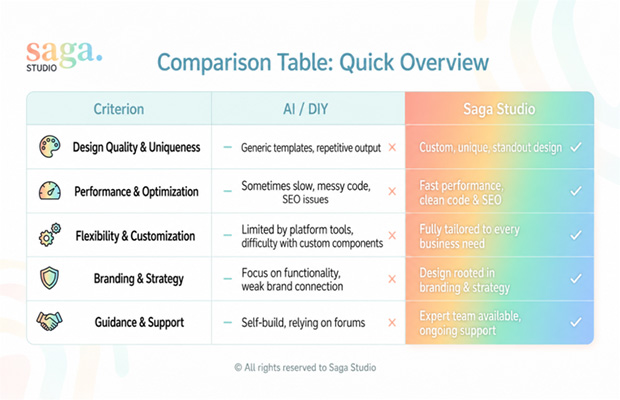
This is no longer a task someone can handle "on the side" by reading a few blog posts. And it is certainly not something an AI tool can automate end-to-end, despite what some platforms claim. Each business has a unique competitive landscape, audience, and set of goals — and effective SEO must be built around those specifics, not applied as a generic template.
What a Professional Studio Brings to SEO
- A comprehensive strategy built around your specific business goals and competitive landscape
- Technical implementation at code level — not just surface-level settings
- Content strategy informed by real keyword research and competitor analysis
- User experience design that converts organic visitors into actual customers
- Schema and structured data implementation for both Google and AI engines
- Ongoing monitoring, reporting, and algorithm-responsive adaptation
- Integration of SEO, development, and design — not three separate contractors
A professional studio sees the complete picture. Instead of isolated actions with unclear connections, it builds a coherent strategy where every element reinforces the others: technical performance enables content to rank, quality content earns links, links build authority, authority unlocks competitive rankings, and rankings drive conversions. Professional work saves significant time, avoids costly mistakes, and eliminates expensive trial-and-error experiments.
The Bottom Line
SEO Is a Business Asset, Not an Expense
Organic ranking in 2026 is one of the most cost-effective and durable marketing channels available to businesses of any size — but achieving meaningful results requires substantially more than adding keywords to an existing page. The businesses generating real organic growth this year are doing so because they have treated SEO as the strategic investment it actually is.
Modern business website SEO combines: a strong technical infrastructure that Google and AI engines can navigate, user experience design that converts as well as it ranks, professional content that genuinely serves the reader's needs, a coherent link strategy that builds domain authority over time, data-driven performance tracking, and the discipline to keep optimizing as the landscape evolves.
Businesses that make this investment consistently enjoy wider organic visibility, higher quality traffic, lower acquisition costs per customer, and a competitive advantage that compounds year over year. Those that do not invest in SEO effectively are leaving a significant portion of their potential market to competitors who will.
"Like a car engine: quality SEO works best when behind the wheel is a professional team that knows exactly how to maximize it. Site design, technical performance, and strategy — all need to work together seamlessly. One weak link in the chain limits everything else."
— Saga Studio | Professional Web Development, SEO Strategy & Digital MarketingThis guide is the fifth and most comprehensive in our SEO series. For earlier articles that provide deeper context on specific topics, explore our complete guide to SEO fundamentals, our analysis of AI tools for website building, our breakdown of website cost and pricing, and our guide to building a professional online store that converts.
Frequently Asked Questions